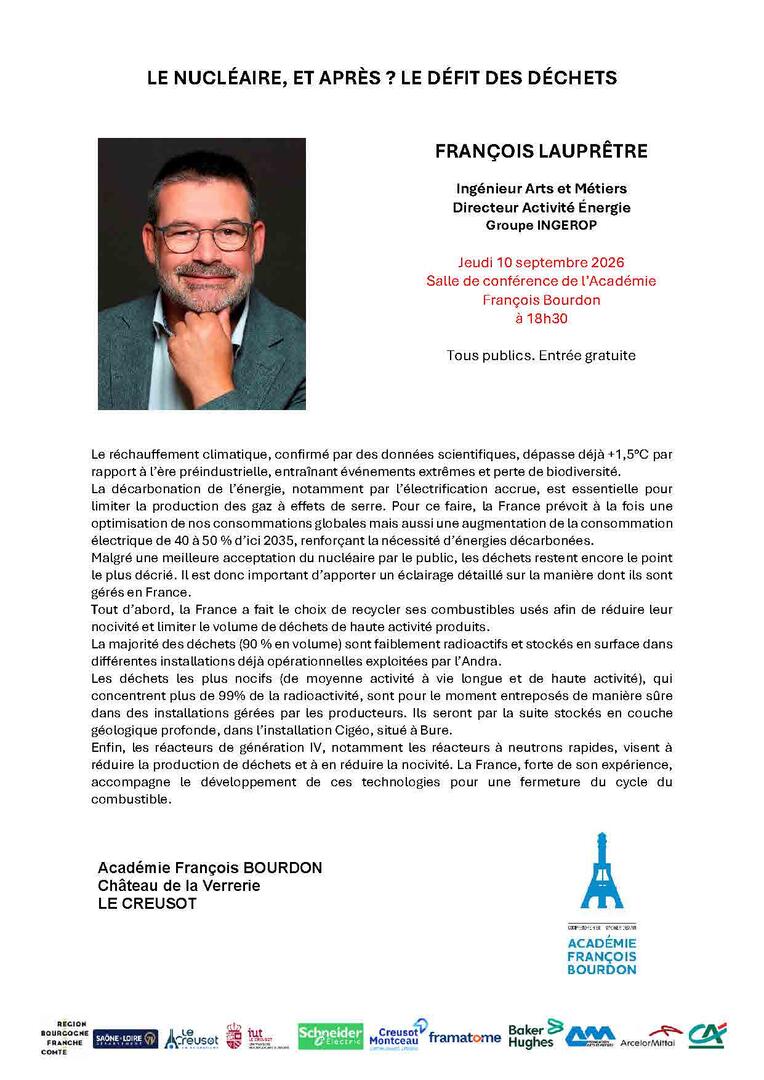
Conference by François Lauprêtre: "Le nucléaire et après? The challenge of waste".
François Lauprêtre is an Arts et Métiers engineer and Director of the Ingérop Group's Energy business.
Global warming, confirmed by scientific data, already exceeds +1.5°C compared with the pre-industrial era, leading to extreme events and loss of biodiversity. The decarbonisation of energy, in particular through increased electrification, is essential to limit the production of greenhouse gases. To achieve this, France is planning both to optimise our overall consumption and to increase...
François Lauprêtre is an Arts et Métiers engineer and Director of the Ingérop Group's Energy business.
Global warming, confirmed by scientific data, already exceeds +1.5°C compared with the pre-industrial era, leading to extreme events and loss of biodiversity. The decarbonisation of energy, in particular through increased electrification, is essential to limit the production of greenhouse gases. To achieve this, France is planning both to optimise our overall consumption and to increase electricity consumption by 40-50% between now and 2035, reinforcing the need for decarbonised energies.
Despite greater public acceptance of nuclear power, waste remains the most criticised issue. It is therefore important to shed some light on how waste is managed in France. First of all, France has chosen to recycle its spent fuel in order to reduce its harmfulness and limit the volume of high-level waste produced.
Most of the waste (90% by volume) is low-level radioactive and is stored on the surface in various facilities that are already operational and operated by Andra. The most harmful waste (long-lived intermediate-level and high-level waste), which concentrates more than 99% of radioactivity, is currently stored safely in facilities managed by the producers. They will subsequently be stored in a deep geological repository at the Cigéo facility in Bure.
Finally, generation IV reactors, particularly fast neutron reactors, are designed to reduce waste production and make it less harmful. France, with the benefit of its experience, is supporting the development of these technologies to close the fuel cycle.
The conference is free and open to all, and will be held in the conference room of the François Bourdon Academy on Thursday 10 September at 6.30pm.